main

Commentary

The Pragmatist’s Arsenal (glass half-full version)

July 8, 2011 — by Sean

We’d like to thank Rob Kirby, one of our many Arsenal-supporting field agents, for the following take on Arsenal’s “imminent” demise.

Don't look back.

The football media establishment says that Arsenal is out of the title race even before anything’s begun. With the imminent exits of Cesc Fabregas and Samir Nasri (on the heels of the £7M Manchester City signing of left back Gael Clichy), pundits have already decided the Arsenal season is done, dead and buried. Supporters, angry over last season’s utter capitulation, are screaming for Wenger’s head, seeing big names go but none coming in.

For the past two transfer windows, everyone was in agreement. We needed a quality goalkeeper, a rock-solid central defender (or two) and a defensive midfielder as backup and competition to Song. And for the past two transfer windows, we got none of them. And now we need a left back and two attacking midfielders, as well? That’s over half the starting XI!

Reality check:

On the GK-side, Szczesny emerged as a badass last season (regrettable Carling Cup fiasco aside). And even Fabianski showed he wasn’t contractually obligated to suck all the time.

Vermaelan, our first choice center half, spent the entire year injured. But now he’s back. Koscielny enters his second season in the league, better adjusted now to the physicality of the Premiership. Meanwhile, Wenger truly seems be on the reinforcements track this time around. (Perhaps someone will even deliver us from Squillaci, while they’re giving us the upgrade…)

The loss of Fabregas can’t be understated, but it’s been a long time coming. Thankfully, Wilshere had a full season to play beside him and learn from one of the masters. And not only did Song put in a solid shift, adding goal-scoring to his bag of tricks, his body seems largely immune to the team’s uber-susceptibility to injury.

But no one chooses to focus on that. It doesn’t sell papers, and if there’s one thing publishing papersellers like, it’s paper sales. So Fleet Street shrieks with the histrionics and the exclamation points. Doomsayers insist that the exit of three players, all of whom have been tipped to leave from the past six months (Nasri, Clichy) to 2 years ago (Cesc), spells the end of the Arsenal Top Four dynasty, not to mention any title aspirations. And wait, crap, Arshavin may go, too! Not to mention the players the club wants to let go: Denilson, Diaby, Almunia, Eboue, Squillaci, Bendtner and Rosicky. It’s an exodus of mass proportions! Forget Champions League, we’ll be battling relegation!

Get real.

NewsVideo

WWC: Erica Turns on the Style

July 8, 2011 — by Mark1

Sure, Copa América has Messi, Forlán, and Neymar.  Yes, it will be a very interesting test for Mano Menezes.  Yeah, it’s nice to see the young Brazilian and Argie talent that’s been shining in leagues around the world.  And I’ll grant you that, despite lackluster performances from Brazil in its first game and Argentina in its first two, there are good reasons to expect both to put on an offensive show in this Copa America.  Both Brazil and Argentina are using very offensive schemes, and both have players who can make things happen. Plus the third traditional power in South American soccer, Uruguay, has a pretty good team, the one that went farthest in the last World Cup and the one with the best player from that tournament.  And we can’t forget Chile or Colômbia, both of which bring some interesting players.  There are lots of reasons to watch this Copa America.

But the best goal you will see this week has nothing to do with the umpteen forwards on Argentina’s roster or the other offensive stars playing in Copa America.  It’s from the Women’s World Cup, up in Germany where it’s warm (it feels weird writing that).

Specifically, from the Brazil-Brazil… er… Equatorial Guinea – Brazil (about 2/3 of the EqG players on the field were Brazilians) game played yesterday.  Not surprisingly in a game between two teams with Brazilian players, this goal was scored by a Brazilian.  It was a real Brazilian Brazilian wearing Brazil’s colors.

Oh, OK, you say.  It must be Marta.

Surprisingly, no.

Just watch what Erika does to score the first goal.

Then watch it again and marvel at how natural she looks doing this unbelievably difficult thing PERFECTLY without having time to plan or prepare for it.  Oh. Mah. Gahd.

If anyone beats that at all in either of these tournaments, it’s likely to be Marta, but I doubt even she will do it.  She was involved in both of the other goals in the EQG-BRA game, both scored by Cristiane.  She had a nice assist on the second goal and was fouled in the area, leading to the third on the PK.  She let Cristiane, who hadn’t scored in the tournament before the second goal in this game, take the PK and get to two goals.  If I understood correctly, if Marta had taken it and scored, she would have become the all-time highest goal scorer in WWCs, like Ronaldo is in the men’s version.  I guess she figures she’ll still have time to get there.

Commentarytransfers

Arsenal set out to lose title in 2012

July 5, 2011 — by Tyler

Nasri out the door for Miami-based chicken fighting league on higher weekly wages than current Arsenal offer.

So, Clichy is off to Man City. Better him than Sagna, for our right back is quite a feisty, efficient, and productive gem. (Ohh, I love me some Sagna! He won’t ever leave, will he?)

In addition to Sagna, “those who won’t leave, or we’ll be in real trouble”: Song, Wilshire, Ramsey, van Persie, Vermaelen, Djourou, Walcott.

The rumour-mill has Nasri and Cesc leaving soon. I want to say “good riddance”, but it just doesn’t feel right to be that angry…

If Nasri leaves, then there is a huge gap in the Gunners’ Clichy-less left side. English-boy Kieren Gibbs can fill left-back or left-midfield, but he needs experience… Another signing would be in order should Nasri flee. The gossip columns mention Villa’s Stuart Downing as a possible signing?

It will be an interesting summer for sure. Wenger has padded-pockets for the first time in a while, so what’s the next chess move in the Professor’s mind? Has his youth-minded strategy backfired, is Arsenal a breeding ground for talent that will eventually leave for greener pastures? Or has he something else up his sleeve?

Is an overhaul in order? Perhaps, but Wenger doesn’t work like that.

Arsene has already enticed two teenagers from Barca’s youth academy to sign for the Gunners this summer, infuriating the Catalans to no end. (So delicious, the off-field rivalry that is Barca-Arsenal).

But Arsene is conservative to a fault. We would love to see Wenger sign 5 more players this summer, but I predict he signs 3 more at most.

I think the consensus is that we need a few big, steely, Brits.

Get Given, get Gary Cahill, get Downing, get Scott Dann, and please, please, please, go after the artist presently known as Leighton Baines.

F— it, I read an article today that suggested Wenger should get Joey Barton! At this point in Arsenal’s history, why not?

Commentary

A Quintuple-header of Matches Today: Euro U21 & Gold Cup Semis, Copa Libertadores Final

June 22, 2011 — by Suman

Anyone up for watching five matches today?

We’re nearing the end of the lull between the end of the European club season and the start of the major international tourney of this summer (Copa America, which starts a week from Friday)–but the three remaining competitions we’ve been tracking converge today, yielding up five matches to watch: the semifinal matches in both the UEFA U21 European Champions and the CONCACAF Gold Cup, and the 2nd leg of the Copa Libertadores final between Santos and Peñarol. Here’s today’s schedule:

All Times U.S. Eastern Daylight Time (UTC−4) (Local Times in parentheses)


UEFA U21 European Championships Semifinals (fixtures via here)

22 June 2011
12:00 (18:00)
Spain Semi-final 2
12:00 (18:00)
Belarus Viborg StadionViborg
Referee: Markus Strömbergsson (Sweden)
Preview

22 June 2011
15:00 (21:00)
Switzerland Semi-final 1
15:00 (21:00)
Czech Republic Herning StadiumHerning
Referee: Robert Schörgenhofer (Austria)


(Both these matches will be broadcast live in the US on ESPN Deportes and also available for streaming  on ESPN3.com.)

Spain is the clear favorite and the team to watch (in order to see young Spanish stars like Javi Martínez (Athletic Bilbao); Juan Mata (Valencia); Adrián López (Deportivo La Coruña); and the Barcelona trio of Jeffrén, Bojan Krkić, and Thiago Alcântara (although looks Barcelona is selling Bojan to AS Roma, and both Jeffrén and Thiago have been mentioned in transfer rumors as well).

In any case, it should be a cakewalk for Spain today against surprise qualifiers Belarus (who advanced out of Group A ahead of Iceland and hosts Denmark based on goal difference). We don’t know much about the Swiss or Czech squads, but the names that came up on “players to watch” lists and tournament previews were Czech strikers Libor Kozák (Lazio) and Tomas Pekhart (Slavia Prague; previously with Tottenham Hotspur), and Swiss(-Albanian/Yugoslav) midfielder Xherdan Shaqiri (FC Basel).


CONCACAF Gold Cup Semifinals (fixtures via here):


June 22, 2011
19:00 (18:00 UTC−5)
United States v Panama Reliant StadiumHouston


June 22, 2011
22:00 (21:00 UTC−5)
Honduras v Mexico Reliant StadiumHouston


(The USA-Panama game will be shown live on FSC; both games will be on Univision and available for streaming on UnivisionFutbol.com.)

The USMNT seemed to finally get its act together on Sunday, defeating Jamaica 2-0 in the quarterfinals, following decidedly lackluster performances in the group stage: close wins against Canada and Guadeloupe on either side of a shock loss to Panama.  Let’s see if Bob Bradley can get his tactics right and his players motivated to beat Panama this time around–and hang on to his job at least a little longer.

In the other semi, Honduras squeaked by Costa Rica on PKs last Saturday at the New Meadowlands, while Mexico surprisingly needed two second half goals to get by Guatemala.  Prior to that, though, Mexico had been blowing the competition out of the water, and that could likely happen again tonight in Houston.


Copa Libertadore Final – Second leg (fixture via here)

June 22, 2011
20:50 (21:50 UTC−3)
Santos Brazil v Uruguay Peñarol Estádio Paulo Machado de Carvalho (Pacaembu)São Paulo
Referee: Sergio Pezzota (Argentina)


(This match will be shown live on Fox Deportes.)

We watched the first leg match in Montevideo last Wednesday (after following our friend’s journey back to Montevideo over the preceding two days). Even though it ended as a scoreless draw, it was rather exciting and eventful, with missed chances for both sides.  Here is Jonathan Wilson on that match (read the whole column for a typically Wilsonian detailed tactical analysis):

Dispatches

A Peñarol Fanatic’s Journey Back to Montevideo

June 15, 2011 — by Suman

Two weeks ago, storied Uruguayan club Peñarol stunned Argentinian Clausura table-toppers Vélez Sársfield to set up a historic matchup against Brazilian side Santos for this year’s Copa Libertadores (1st leg tonight is tonight in Montevideo; 9pm ET on Fox Deportes in the USA).  A couple days later we received this message from a Uruguayan friend–born and raised in Montevideo as a supporters of los Aurinegros, los Peñarolenses:

Can you take 3 days to go to São Paulo?  I am in some state of delirium.

Here is the story, still in progress, of where that delirium has taken him:

Forlan's Wall Photo - June 2, 2011

After that initial message, our friend (let’s call him Forlán, after another lifelong Peñarol supporter and prodigal son of Montevideo who has gone abroad to pursue his craft; the real Forlán, btw, is a newly inducted honorary member of the club ahead of tonight’s game*) was looking for someone to accompany him on a trip to São Paulo for the 2nd leg (which is next week–Wednesday June 22). But then Monday we received this via email:

date: Mon, Jun 13, 2011 at 4:23 PM
subject: drama begins

I’m at the Philadelphia airport.
The tickets went on sale this morning at 9 and they were gone in 15 minutes.
(Some 24 thousand had been sold before to club members. The stadium fits
around 65 thousand.)
As of now, I’m without a ticket. But there’s always hope.
On top of everything, all flights yesterday and today in and out of Montevideo
have been cancelled because of the volcano in Chile. Looking at the
wind forecast
for tomorrow, I’m wanting to believe my flight tonight won’t get cancelled.
The game itself might get postponed if Santos cannot fly in.

Presumably he’d travelled to Philly from Ithaca (where he summers, playing the beautiful game and doing his mathematics) by either plane or automobile.

We next heard from him later that evening, via IM:

date: Mon, Jun 13, 2011 at 10:35 PM
10:35 PM Forlán: i’m in miami. they canceled the flight to mvd, but luckily i knew just before leaving phl. So now i’m flying to Sao Paolo and sometime tomorrow from there to Mvd.

10:36 PM My brothers were able to get 2 tickets. Need one more for my niece, will try to get it a travel agency in sao paulo (from the tickets for Santos)

And then back on email the next day (yesterday):

date: Tue, Jun 14, 2011 at 2:35 PM
subject: Re: drama begins

Stuck in Sao Paulo. Will fly to Porto Alegre and catch a bus from
there (12 hours).

He left us in suspense overnight–would he make the flight to Porto Alegre and catch the bus? 12 hours on a bus?? Would that even get him home in time for the game??

But then this email arrived just a few minutes ago:

date Wed, Jun 15, 2011 at 10:29 AM
subject Re: drama begins

At home in Montevideo, ready for the game in 12 hours.
A bit rainy and cold. The city awaits the big moment.
Vamos Peñarol!

So the initial leg of the drama is successfully completed–prodigal son of Peñarol completes the odyssey home in time for the next leg..the 1st leg.  Stay tuned..

*: From that goal.com article about (the real) Forlan and tonight’s match–read to the quote at the end:

Commentary

Meathead’s ManU-centric Recap of England-Spain U21

June 14, 2011 — by Suman

Welbeck & De Gea: Opponents on Sunday, Teammates in the Future

We posted on Sunday ahead of the Spain-England Euro U21 Championships matchup, which ended up in a surprising 1-1 draw–a very good result for England.  We got this recap of the game from a longtime ManU supporter that many of know as Meathead (aka @tetedeviande–most recent tweet: “Wesley Sneijder would be a welcome addition to Utd, if for no other reason than Yolanthe Cabau“):

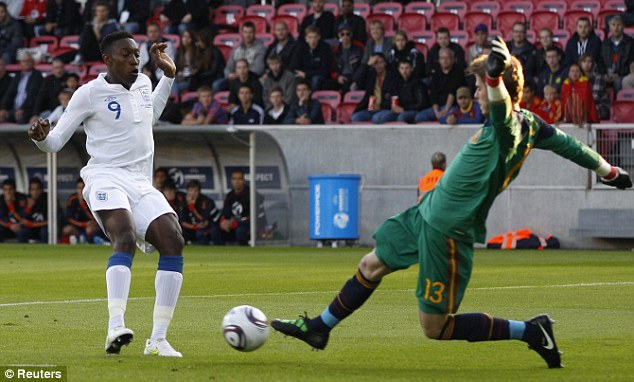
Barcelona may have had their way with Man United, but United boy Danny Welbeck notched yesterday for the England U21s vs Spain!!!!  He showed great calm in front of goal.  Love that kid.  Bojan wasn’t in the Spanish lineup, but Thiago and Jeffren were, as was Herrera, who scored with a hand ball.  Spain is really talented, and they play a lot like Barca.  They also had Juan Mata and Javi Martinez in the side, both of whom are already budding superstars.  That said, England, despite the gulf in quality, never quit.  Smalling was the player of the game for England.  He was immense both defending and in possession.  Jones was not as good, but has real promise.  De Gea made some huge saves, and he looks the real thing.  All in, United had five players on the pitch, if you include De Gea and Jones.  Welbeck scored the equalizer, and I just love that kid.  He is big, fast, strong, and arrogant as hell.  Cleverly looks a good talent as well, though was a bit out of place on the wing.

BooksCommentaryHistory

Scattershot Politics: Sport and Its Serpentine Political Meanings

June 14, 2011 — by Ryan1

n121551_34802317_3451.jpg


[Editor’s note: We welcome back contributing writer and longtime friend Ryan Reft.  He’s kindly allowed us to repost this essay from his groupblog Tropics of Meta.  For some of his past contributions to CultFootball see here, here and here.]

Over the past fifteen to twenty years, historians have increasingly emphasized the role of sports as both a driver and reflection of society.  The recent Bill Simmons-inspired and ESPN-produced 30 for 30 documentary series tackled a number of difficult subjects via sport.  In “The Two Escobars“, directors Jeff and Michael Zimbalist travelled through 1980s Columbia, following the lives of Pablo (international drug dealer/murder/local philanthropist) and Andres Escobar (captain of Columbia’s 1994 World Cup team murdered in a nightclub alteration several months later).  The two unrelated protagonists encapsulated the travails of late 20th century Columbia.  Drug money filtered into the nation’s soccer infrastructure, boosting its competitive success but also adding layers of complexity and violence to a nation already struggling with decades of conflict.  Writing for the Onion’s AV Club, Todd VanDerWerff summarized its importance similarly: “The film’s portrayal of Colombia as a nation that made its compromises and learned to live with the hell they unleashed is also particularly good, as the story of the two men at the center slowly radiates outward to encompass more and more of the nation’s society.”

This is not a wholly unusual conclusion for the series.  In “Pony Exce$$,” director Thaddeus Matula explored the corruption and ultimate destruction of Southern Methodist University’s (SMU) then dominant football program as booster money flowed in from the oil wealth that defined the Southwest US in the 1980s. Though the Southwestern Conference consisted of eight schools (Baylor, Rice, SMU, Texas, Texas Tech, Texas A&M, Arkansas, and Texas Christian University), Dallas served as a hub for numerous successful graduates of each school.  As several observers note in the documentary, football rivalries crackled in the board room meetings of Dallas high rises as alumni from all schools engaged in recruiting practices that seemed to define the decade.

Likewise, Billy Corben’s film,“The U” about the dominance and bravado of Miami University’s 1980s football teams reflects similar themes.  Miami’s football team served to unite a divided city behind a collection of local talent that also rewrote the rules of the game.  Miami’s players excelled spectacularly on the field but stoked controversy with their trash talk and exuberance.  If oil money shaped SMU, Miami’s notoriously tough African American neighborhoods, embraced by Miami’s first successful coach Howard Schnellenberger, came to symbolize “The U’s” power.  Along with cultural productions like Scarface, Miami Vice and the notorious Two Live Crew, players like Michael Irvin challenged college football and its fans.  Unlike “Pony Exce$$”, “The U” reveals the racial undertones that marked some of the criticism faced by the Miami program.  When teamed with Steve James’ masterful “No Crossover: The Trial of Allen Iverson” and the recent “Fab Five” film about the innovative early 1990s Michigan basketball team, “The U” reveals so much more about American life than just college football.  Race, money, and a changing cultural landscape collided.  As one writer observed, James’ movie looks at Allen Iverson “more as a phenomenon, a human inkblot whose polarizing effect on people often says more about them than it does about him. They see whatever they want to see, and that may or may not be the truth.”  In essence, all these films and others in the 30 for 30 series function to elevate sports to a level of political and social importance that might have been derided in early decades.

“Architecture is the simplest means of articulating time and pace of modulating reality and engendering dreams.  It is a matter of not only of plastic articulation and modulation expressing an ephemeral beauty, but of a modulation of producing influences in accordance with the eternal spectrum of human desires and the progress in fulfilling them.  The architecture of tomorrow will be a means of modifying present conceptions of time and pace.  It will be both a means of knowledge and a means of action.” – Ivan Chtcheglov, Forumulary for a New Urbanism, 1953


Writing in 1953, nineteen year old architect and devotee of the Situationist movement, Ivan Chtcheglov published his sweeping indictment of mid-century urban planning.  For Chtcheglov, the architecture of cities past reflected the dead life of capitalist production.   City dwellers had been hypnotized by the built environment, thus, focusing exclusively on capitalist accumulation to the extent that when “presented with the alternative of love or a garbage disposal unit, young people of all countries have chosen the garbage disposal.”  One can see parallels with sport, most clearly in the above examples regarding SMU and the Escobars. The excess capital of drug and oil money created a vehicle for the egos and dreams of ruling classes that were then imposed. (To be fair, soccer teams as several interviewees in The Two Escobar note, serve as great money laundering devices.  One might suggest the same of Enron and other corporate entities in recent years.)
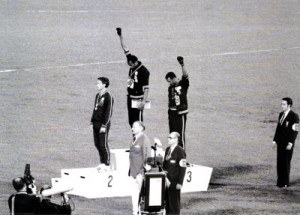
For Americans, sports provided both meaningless entertainment and incredible important cultural moments of resistance.  Dave Zirin documents athlete resistance of the twentieth century in his 2005 work, What’s My Name, Fool? Sports and Resistance in the United States.  To Zirin’s credit, What’s My Name, Fool? gathers countless examples of political acts by athletes across the sports spectrum, engaging in issues of race, gender, and class.  For example, Zirin traces the complicated politics of Jackie Robinson who, despite his bravery in desegregating MLB, came to be unfairly seen by radical Black nationalists of the late 1960s as a sell out. Some have described Zirin as sort of Howard Zinn of spors journalism.  Perhaps.  He does look at major historical events like the 1968 Mexico City Olympic protest by Tommy Smith and John Carlos, in which both athletes upheld closed black gloved fists.  Zirin explores many facets of the event that had gone unnoticed.  Unfortunately, while Zirin collects valuable stories worth reflection, he too often veers in the direction of soap box oratory. Moreover, Zirin seems to feel the need to conclude paragraphs with zingers. For example, how about this gem regarding the failure of several WNBA sports franchises: “while some franchises found success, others have folded faster than a rib joint in Tel Aviv.” (186)  When discussing Allen Iverson, Zirin notes Iverson’s role as an anti-corporate anti-hero summarizing his nickname may have been A.I. but “there was nothing artificial about him.” (163)  Nuance is not the most prominent feature of  What’s My Name, Fool.  Still, even if the equivalent of street corner radical, Zirin contributes something to our knowledge of American culture and sport.

If baseball and to a lesser extent American football and basketball have served as venues for political expression, predictably, football occupies a similar position for Europeans. In How Soccer Explains the World: An Unlikely Theory of Globalization, Franklin Foer traipses through countries around the world, but predominantly Europe, exploring the meanings and processes that manifest themselves in the sport. Throughout How Soccer Explains the World one thing becomes clear, the political complexity of football and more generally, sport, radiates in countless directions.  When Foer presents Barcelona’s “bourgeois nationalism” as a model for 21st century cosmopolitanism,  he goes so far as to claim that it “redeems the concept of nationalism.” (198)  For Foer, Barca never demonizes opponents the way supporters at Red Star (Belgrade- the subject of a previous chapter, one that found soccer fan bases and clubs of the former Yugoslavia as germs for the paramilitary organizations of the Balkan wars in the 1990s) have. Instead, Barca illustrates that “fans can love a club and a country with passion and without turning into a thug or terrorist.” (197)
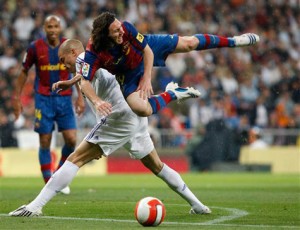
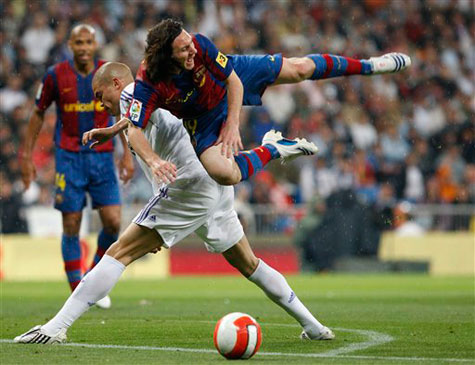
A central aspect of Barca’s identity rests on its foundational myth, its role as a means of Catalan resistance toward the post Spanish Civil War fascist Franco regime. According to this myth, Camp Nou, Barca’s legendary stadium, enabled Catalan fans to express themselves in ways forbidden by Franco.  Camp Nou allowed for political and social subversiveness. “Its fans like to brag that their stadium gave them a space to vent their outrage against the regime,” writes Foer.  “Emboldened by 100,000 people chanting in unison, safety in numbers, fans seized the opportunity to scream things that could never be said, even furtively, on the street or in the café.” (204) Yet, as Foer acknowledges, there is another way to view Barca’s history.  More likely, Franco saw Camp Nou and Barca as harmless outlets for his repressed populations.  Unlike the Basque region and its terrorist/separatist movement ETA, Catalonia never developed any similar liberation fronts.

Preview

Euro U21 Championships Underway – England v Spain Today!

June 12, 2011 — by Suman

Now here’s some football to watch over the next couple weeks: the UEFA U21 Championships started yesterday in Denmark.  Eight teams are competing: Spain, England, Iceland, Switzerland, Ukraine, the Czech Republic, Belarus, and the hosts Denmark; and two of the favorites meet in their first group stage match later today: Spain plays England at 2:30pm ET (in the US, you can watch the game on ESPN Deportes or ESPN3.com).

The Spain squad features two players that were reserves on last summer’s World Cup champion senior national team (midfielders Javi Martínez of Athletic Bilbao and Juan Mata of Valencia), as well as three players that saw bits of playing time with Barcelona this past season (JeffrénBojan Krkić, and Thiago Alcântara).

Interestingly all three of those Barça players have roots outside of Spain. Alcântara is tipped by many as the next great Barcelona midfielder; he was actually born in Italy to Brazilian parents, and quite fine footballing parentage at that–his father is Mazinho, who earned 40 caps playing for the Selecao, including in the 1994 World Cup winning squad.  Thiago was born in 1991 while his father was playing club ball in Italy (for Lecce and Fiorentina), and grew up Spain (where his father played for Valencia and Celta Vigo).  See this Sid Lowe column from last November about Thiago.

Similarly, great things were also expected of Bojan (whose Serbian father was also a professional footballer). He became the youngest ever player to play for Barcelona in a La Liga match and a Champions League match, soon after his 17th birthday. But lately he’s suffered from injuries and didn’t feature much in this past campaign, especially after Ibrahim Affelay arrived in January and became the first attacking option off the bench.

Jeffren is another talented attacker who spent most of this season on the bench, although he did write himself into the Barcelona history books by scoring the 5th goal in the November El Clasico. Jeffren was born in Venezuela, but immigrated to Tenerife with his family at a young age. Like Thiago and Bojan, he was signed by Barcelona before the age of 15 and grew up in La Masia.

England, on the other hand, made more news for the players that have been called up for the senior national team and aren’t playing in this tournament (Arsenal’s Jack Wilshere and Liverpool’s Andy Carroll).  From Mr. Zonal Marking Michael Cox’s preview of how England might line up:

Manchester United fans will look forward to seeing their probable future central defensive duo of Chris Smalling and Phil Jones play together at the back – they’re likely to be joined by recent Hamburg signing Michael Mancienne and Chelsea left-back Ryan Bertrand in a strong-looking back four, with Frank Fielding in goal. Another option is to use Spurs’ Danny Rose in the left-back position he’s occasionally played at club level, although he prefers to play on the left wing.

The midfield will be anchored by Fabrice Muamba, with new Liverpool signing Jordan Henderson and Everton’s Jack Rodwell as part of the midfield three. Rodwell could sit alongside Muamba and allow Henderson to create higher up the pitch, but in the recent 2-0 friendly win over Norway’s U21 side, it was Rodwell who provided the most frequent support to the front two of Welbeck and Daniel Sturridge.

That makes England’s likely starting XI: Fielding, Mancienne, Smalling, Jones, Bertrand, Muamba, Rodwell, Henderson, Rose, Welbeck and Sturridge. Right-back Kyle Walker and midfielders Tom Cleverley and Mark Albrighton are other options.

Sturridge and Welbeck make for a potent strike force.  Muamba is player to watch–not least for US fans since he pairs with CultFootball favorite Stu Holden in Bolton’s midfield.  His story is also a remarkable one–from his birth in Kinshasa in 1988 to playing the Premier League and representing England internationally.