I’m really excited about the EPL starting. I’m out of town, and I won’t be able to see any of the games live, but I’ve set my DVR and I’m sure no one will text or tweet or email about results. When I get back home on Sunday night I’ll just sit on my couch and watch kickoff as if it was only just happening at that moment.
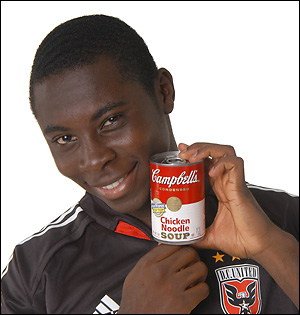
And since I don’t even want to even think about the EPL I’ll turn my brain energy upon the return of Freddie Adu to the United States and MLS. The little Ghanaian is back from a harsh go in Europe. I blame the system.
Here we had a promising young player, who maybe isn’t really as young as we say he is (that one’s for you, Conspiracy wonks). We send him overseas to be developed. He moves to Benfica during his late teens, a stranger to the culture with his head full of grand ideas bled in from agents and sportswear marketers. His confidence dissolves while he’s alone in a foreign land. He struggles and is moved and moved, and so far we haven’t seen the player for whom we’d hoped.
It’s unlikely he had adequate support when he most needed it, but that’s par for the course when bringing in foreign players to a strange system thousands of miles from their homes. Many clubs buy their athletes for big money then drop them into play as if they were a new part, unpacked from the shop. Kids fall through the cracks, unable to keep up with the demands of advanced football while simultaneously finding a home, learning a language, figuring out how to get laid. It’s tough out there.
So he’s back. Philadelphia, a city whose teams I support to the one—the one being the Union. There was no Union when I lived in the Delaware Valley. In theory, I support the Red Bulls. In theory, because I don’t really pay them much mind. But they’re my local team, and while I’m happy to see if Feddie can blossom in the city of brotherly love, he can also go to hell.
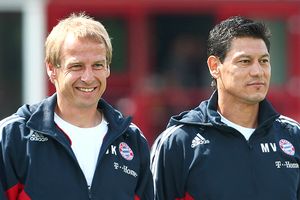
My concern with Klinsmann is exactly the one lots of commentators have already cited–he’s not really a tactician, and it was Jogi Löw who did all that heavy lifting with the German National Team. And Martin Vasquez, who went from being an assistant at MLS’s Chivas club to being Klinsmann’s assistant at Bayern (and came back for a short tenure as Chivas’s head coach), isn’t really a tactician either–but he seems to impress folks since he got the Youth Development Director position with Real Salt Lake post-Chivas. I like Dooley as a possible assistant. He would seem to bridge some of the American/German dynamics. And Tab Ramos is still in my eyes the best player ever to wear the shield (sorry to the Claudio Reyna and Landon Donovan fans), and I think he has high potential as a coach. This might be an audition for him with the u20s or 23s since he’s the interim there. I think it would make sense to have Claudio as the new technical director to be on the staff in some capacity. But having a big-time tactician on board is key. To make a cross-sport analogy, Phil Jackson was always the big picture, motivation, keeping the team in balance guy, while he let Tex Winters install and run the offense in the Triangle. I think that’s the dynamic (at least that’s the word coming out of Germany after the hire, and also previously during the multiple Gulati-Klinsmann flirtations). So the question for me becomes: is there a dynamic tactician somewhere in the ranks of USMNT youth squads, or MLS, or elsewhere. Sadly this person will probably have to come from his old German contacts.
In terms of who I would like to see him bring in–there’s Peter Nowak. Now this might be my Chicago Fire bias, but he’s a former international for Poland, and has worked in both MLS and the US youth systems. I realize that as a former Bradley assistant he might be fraught with baggage, but I think he might add some “bite” that complements Klinsmann. Other guys I think would be interesting as assistants are Dom Kinnear and Franky Yallop, who I got to watch and talk to when I was coaching in Nor-Cal when they were with the Quakes (or Dynamos now).
I tell you who I DON’T want to see in the assistant positions Sigi Schmid or Rongren. I’ve never been impressed with Schmid at any of the levels he’s coached at–UCLA, Galaxy, etc. And Rongren made some COLOSSAL mistakes in my opinion in terms of who brought in to camp and did/didn’t develop in his time with the U-20’s. [Editor’s note: read the sad (for US Soccer) Subotic saga.]
I’m cautiously optomistic on Klinsmann generally. I don’t think he’ll be the savior that some think he will be, in part because of the need to change soccer culture vis-a-vis player development, which will be a long time coming.
Finally, on a player selection note, I’d like to see him bring in (Stanford Bias Warning!) Chad Marshall. He had a good run with the U23’s on the back line, played well as a center back for the Columbus Crew last year, and was in the WC2010 camp, so hopefully he can get a longer look.
I have to say, I have empathy for the looters. When you see no other option for survival, I totally understand the mindset of trying to obtain what you need to live. Of course, I’m talking about those who tried to loot food and water in Somalia – not the idiots in London right now who are stealing televisions, clothing and anything else they can get their hands on.
This is not something I wanted to be writing about – my intention this week was to give a Premiership preview with some analysis of where each team stood. Instead, I’m spending my time reading reports about London, a city I lived in for nearly 8 years, being in flames and destroyed by rioters. I just wanted to offer a few thoughts about these events and will then provide a very brief prediction for the new season, whenever it may start.
Mindless destruction
Nominally, this all started because a man was killed in Tottenham, North London, by a police officer. There are conflicting stories about the events that lead to this death, and they will come out in the investigation, but I think it’s important to recognise this has nothing to do with that event at this point. There was a peaceful protest from the family of Mark Duggan, the man who was killed, requesting more information from the police, but for people to use that as a reason for this mindless violence and destruction is a complete fallacy. Whatever happened in that incident, I feel great sympathy for the family of Mr. Duggan, and for the police officers who were involved in the incident. If mistakes were made on either side, it would be difficult enough to come to terms with – to have the event be referred to as the catalyst of all this rioting must exacerbate it greatly.
Trying to work out the true reason for these riots is much more difficult – obviously economic downturn and a hot summer are contributing factors, but there are plenty of other places where those issues exist and people manage to get along without rioting. The British National Party (the BNP – an extremist, racist group) will try and blame the influx of ethnic minorities to the country – indeed last night their Chairman and (somehow) Member of the European Parliament Nick Griffin tweeted that “In all the radio and TV Interviews I’ve heard from London, I’ve only heard one real London accent” – as if talking like Dick Van Dyke in Mary Poppins* would abate any trouble. Griffin is doing his best to turn this into race riots, my fear is that he is going to be successful. Thus far, from what I have seen the looters/rioters/arsonists/criminals/twats have been from every ethnic background – a potential descent into a race riot makes this all the more frightening.
*I’m kidding, his accent was terrible
One final point I would like to comment on, is the idea that those who are rioting are doing so because of poverty. I know everything is relative, but there are real issues in East Africa right now, famine is killing tens of thousands of people and it is a humanitarian crisis of epic proportions. Idiots in the UK are grabbing the headlines with their mindless violence, in the US everyone is focused on the economy and the amount of money companies were worth went from ‘a helluva lot’ all the way down to ‘slightly less than that’; meanwhile people are starving to death. These people have real problems, not ones created by bickering governments or opportunistic thugs – danger to ordinary people in the UK is very real now, I’m saying it is completely needless and could be stopped in an instant if the rioters realised the error of their ways. The same is not true in the Horn of Africa, the situation is tragic and they need our help. If you can, donate to help to those most in need.
I am an Arsenal fan. (It sounds like one’s first words at the first address of a self-help meeting.) I check the Web every day to see if finally the drip-drip waterboard torture is finally over and we’ve either signed someone (I quadruple finger-crossed on the Juan Mata deal; I’m still doing so) or resolved anything with regard to Fabregas and/or Nasri. But sometimes, you just have to let go. And on that note, time for something different.
By the standards of soccer allegiances and soccer fandom, I’m a newbie. And American, to boot. In 2006, an NYC friend who supported Arsenal wove a magical tale of a manager who could conjure success on a shoestring budget. He spotted the diamonds in the rough time and time again. He built a team that fought the good fight, sidestepped the slide tackles and nutmegged the thug teams with flowing, attractive play. Perhaps the team did not note-for-note emulate the total football of the 1970s Dutch national teams, but then, who did? Furthermore, we had Henry, the best player in the world, or so the song went. [Editor’s note: he was. Okay, that wasn’t the editor noting, it’s still me. But look at Henry’s goals on YouTube sometime. Cagey, cheeky Frenchman.]
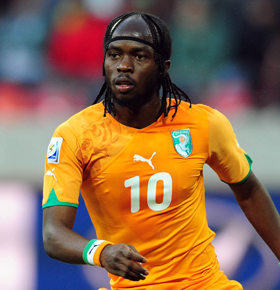
Anyway, it occurred to me moments ago that for the first time in my tenure (obsession) with Arsenal that we now finally have a player who goes by one name. And he’s not even Brazilian. Just a good ol’ boy from the Ivory Coast named Gervais Yao Kouassi. I mean, Gervinho.
OK, caveat number one, we have/had Denilson, but I’m choosing to ignore him. He’s on loan, he’s disappointed greatly as a player, he causes nightmares in soccer dreams…so the assertion stands.
Caveat two, we had Eduardo, and Eduardo ruled until some Cro Magnon from Birmingham mistook Eduardo’s leg and ankle for a brick wall and mistook himself for the brick-busting Kool-Aid Man/ Pitcher. Nothing about it is funny, and it still pains me to have lost Eduardo, but I can’t help myself: “Oh yeah!” (I really do love the Kool Aid Pitcher guy.)
I should have chosen a different metaphor.
But my love for Eduardo’s fox-in-the-box style means that I have wholly blocked out this memory. He scored against us last year with Shakhtar Donetsk? What? Is that even a real team? Who are we talking about again? Ed-what? Crozillian? Doesn’t ring a bell.
Onward and upward. It can’t be denied that sometimes less is more. And please do me the favor of not reading this as some tired rationalization I’ve trotted out through the years re: endowment, or lack thereof. Get your minds out of the gutter and stick with me here: one namers bring success.
For once they are excited about something other than sleeve tattoos and sticking it to the man!
Ahhh, the magic of MLS. The alchemy of the United States’ professional soccer league remains an elusive beast. While most observers would agree that the league’s play has improved dramatically during its existence (one could argue that it’s the equivalent of the Mexican league though admittedly it remains a tenuous argument and really few defenders in the MLS meg opposing forwards in their own defensive third so maybe the MLS still has a way to go), its skill level remains, well frequently uninspiring. At least in its current incarnation the league provides a medium for developing American talent, even if one gets the sneaking suspicion that Landon Donovan and others like him would benefit from more European or English competition (to Dononvan’s credit his brief time in Everton was very fruitful and proved Donovan could compete at the level of the premiership).
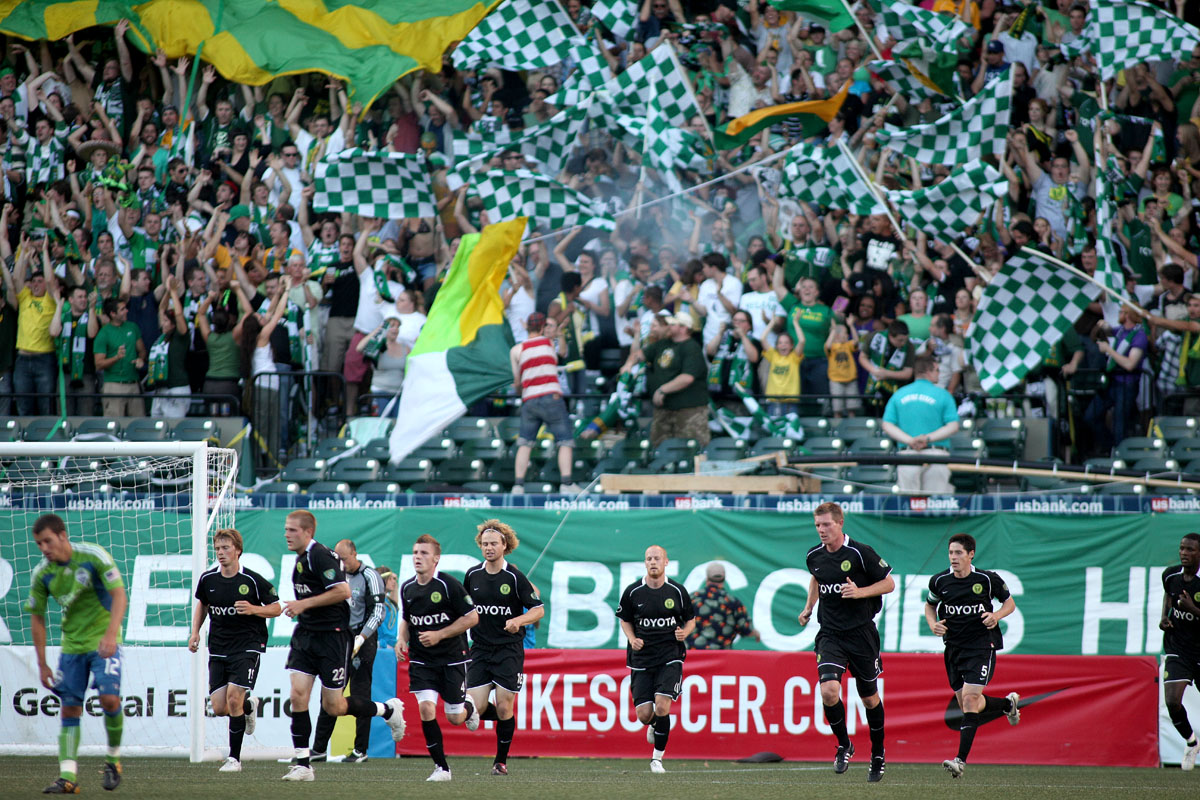
Still, even if play has improved, how much has the fan experience benefited? Hard to say. Like most things in life, it seems to depend on where you are and the local demography. For example, take all the recent hoopla over the Portland, Vancouver and Seattle franchises. Chris Ryan’s recent article on grantland.com provides a fine example. The rivalry that has emerged between the neophyte sides of Seattle and Portland serve as the best stories out of an MLS summer overshadowed by the Women’s World Cup (and the glorious insouciance of Hope “Han” Solo). Between the natural rivalry that exists between the jewels of the Pac Northwest and the established histories of both clubs (The Portland Timbers and Seattle Sounders were both established A League franchises and the two cities had an NASL rivalry as the aforementioned Ryan points out.), it should probably not surprise anyone that the two franchises have done so well. Moreover, their natural rivalry outside of soccer, such as the once famous Sonics-Blazers battles symbolizes the kind of excitement that has emerged around soccer fixtures in the region. One need only look to IFC’s hysterical Portlandia for further evidence of the Pac Northwest blood feud.
Inappropriate? Yes! But at least you're paying attention.
The hipster aesthetic probably doesn’t hurt either, after all, even though Grizzly Bear Blitzen Trapper Sleater Kinney (ooh I think I dated myself on that last one) lovin’ bohemian might eschew more traditional sports, soccer retains some kind of alternative credibility in America. Granted, it boggles the mind that a predominantly white suburban sport (on American shores that is) still harbors an alternative identity, but its cosmopolitan international nature seems to mystify the fixed bike gauged pierced afficianados of the American Pacific Northwest.
At sports bars and gyms and generally anywhere Americans congregated Sunday, people celebrated soccer like it was the national sport. Until last week, I doubt if hardly anyone knew a Women’s World Cup even existed, let alone any player’s name, from any country. But as with the Olympics, if any American is in the running for the gold for any sport, be it badminton, fast walking or synchronized swimming, people who may have badmouthed the sport just the day previous keep their eyes glued to the TV. As a nation, we are ardent fans of [fill in the blank], provided there’s a medal involved.
The thrill of the soccer pitch thrilled like never before, literally. Every shot on goal elicited gasps, clapping, hoping against hope, you name it, by yes, the very same people who say soccer isn’t a real sport like American football. Politics may split America into roughly equal halves, but when it comes to winning something, the country bands together as one, jingoistic as jingo can be.
Admittedly, that was somewhat of a rant. But as everyone loves bitching and whining, I’ll continue in a related vein.
The majority of Americans have always denigrated soccer and deemed it downright wimpy when compared to American football, even if all evidence points to the contrary. Slide tackles, snapped legs, knees and ankles, cleat studs raked across faces, all without the full body armor of American football, these are but details. And why does it matter? Extreme physicality and the threat of real bodily harm exist in both sports. I’ve heard people disdain baseball for being boring but never for being less violent than football. And what of basketball, the pushing and the pulling in abundance, but if it gets too rough you can bet the man in the black-and-white stripes will blow his trusty whistle.
In his How Soccer Explains the World, Franklin Foer theorizes that although American upper middle-class parents champion soccer for kids at early ages for confidence building and team play, it’s only as a sports placeholder. Parents cleave to the “let’s not keep score, everyone wins” kindergarten mantra until the child (or boy, really) can at last strap on the body armor and do battle on the football field. Much of the American football hegemony stems from inertia (father’s father taught by his father, and now onto the son), as well as class (in non-Latino communities, few inner-city kids are similarly encouraged to play at a young age). Soccer gets tagged as a sort of yuppie’s game, which is deeply ironic in a global perspective. Soccer is one of the few sports that anyone of any income bracket (and really, of any size) can play. Ask Maradona, for example.
Walter White would understand it at least. He knows all about the the curse of wanting more, that however much you have, it’s just never enough. Yes, Spurs’ player of the year for 2010-11 Luka Modric, now reminds me of the meth cooking protagonist of AMC’s Breaking Bad (returning on Sunday for season 4).
In the first episode of the second season of Breaking Bad, Walter White works out exactly how much money ($737,000) he would need to make, in order to provide for his family if he is unable to beat lung cancer. However, by midway through season
Luka Modric's alter ego - Heisenberg
3, he has abandoned all plans to limit his expedition into the world of narcotics production and is working full time for a drug-king-pin-slash-chicken-frier in Albuquerque. Why? Because, whether or not Walt had convinced himself that he was only in it to ensure his family would be taken care of in the event of his death, the money and the power that came with being the best meth cook around was a feeling he wanted to chase.
Luka Modric has recently put in a transfer request in order to try and force through a move to Chelsea, a deal that has currently not been agreed upon as the Stamford Bridge club has not matched Tottenham’s valuation for their star midfielder. Last year, Modric signed a contract with Spurs until 2016, a commitment he no longer wishes to honour. Despite still having 5 years left to run on the deal, it is highly unlikely Modric will still be a Tottenham player by the time the new season begins in August. So why does he want to move? In his words, he wants to play for a “big club like Chelsea, compete in the Champions’ League and have the chance to win trophies”. Or to put it in simpler terms, because they will pay him more money and, the more exposure he has on the biggest stage, the bigger star he can become. Luka Modric, Croatia’s answer to Walter White.
The only part of Modric’s reasoning I can understand or accept, is that he wants the opportunities to win trophies. This is part of what has been ruining modern football, people no longer value winning things over all other measures of success. Nowadays, all that is talked about is finishing in the top 4 of the Premier League in order to qualify for the Champions League. Why is this important? So you can attract the best players to come to your team which will mean you can stay in the top 4 and continually play in Europe’s top competition. I understand why this is important to a club’s Chairman, or shareholders, but why are players simply interested in taking part? Merely playing in the Champions’ League is irrelevant if you do not actually win the trophy. I say this having fully enjoyed Spurs’ exploits in Europe last year, taking on the top clubs, but if this becomes an annual event and goes no further, I do not see how this is a measure of success. What goes in the trophy cabinet, a framed
For all you know, I didn't spend 10 minutes finding one with Spurs above Arsenal
copy of the end of season “League Ladders” showing the top 4 finish? Yet season after season, this is all that is talked about. Honestly, I am excited for Tottenham to be in the Europa League next year, as I believe we have a fantastic opportunity to win it – the same would not have been true in the Champions’ League.
Or at least, we would have had a great chance to win the Europa League, if one of our star players did not want to jump ship and try and win things the easy way. It’s similar to LeBron James, who could have stayed in Cleveland and tried to win a Championship the right way, show loyalty to his team and help them build something with him as the lynch pin. Instead, James went to join his buddies in South Beach and Modric wants to go to a “bigger club” like Chelsea. When I break it down, that’s the part that really bothers me – to think that people now consider Chelsea a big club. In the late 1980s, when Chelsea were struggling in the top flight and were relegated to the old Division Two, they were struggling to pull in an average crowd of 8,000 a week. Now they have some success and the place is full of “life-long Cheslea fans” – Spurs fans, of course, are always happy to remind them of their bandwagon jumping singing “Where were you when you were shit?” at them. But for a lot of football fans now, who think that the league started in 1993 with the advent of the Premiership, Chelsea are one of only 4 teams to win the title. For those with even shorter term memories, Chelsea have indeed been in the Champions League every single year (since 2003/4). When they are reflecting back on this era of Chelsea’s history (wanted to put that in quotation marks but even I will avoid being that snarky!), they should put a statue outside of Stamford Bridge not of money man Roman Abramovich, or the man who built their first title Jose Mourinho, or Assistant Referee John Terry, but of Jesper Gronkjaer.
On the last day of the 2002/3 season, Chelsea and Liverpool faced each other in a battle for 4th place, the Scousers needing a win to snatch that place from their London rivals. The game was won for Chelsea by Jesper Gronkjaer, who put in the cross for Desailly to score the first goal, and then scored the winner in the final 10 minutes, the match ending 2-1. That match was the catalyst for all of Chelsea’s success – and that is not an imagination. A few months later, Chelsea were within 5 days of going into administration, having overspent in the pursuit of glory. Roman Abramovich, Russian billionaire, was looking for an English Premier League club to invest in, because of their location in London and their status as having qualified for the Champions League, he stepped in and saved Chelsea and the rest, unfortunately, is a very successful history – 3 league titles, 3 FA Cups, a League Cup and a Champions League Final they would have won, if John Terry could take a penalty. (Things I love about that clip – the way the commentators are going on about “Mr Chelsea” and what a great leader Terry is, as the man himself is adjusting his Captain’s Armband to ensure the Big “C” is visible; and the shot of all the Chelsea players arm-in-arm united to the death…until he misses and then it’s every man for himself and the hugging is gone – brilliant).
I get it, Chelsea are now probably what everyone would define as a bigger club than Tottenham, because money talks. But just money is not why I watch the game, it’s not what gets me excited. Manchester City did fantastically well to qualify for next year’s Champions League – and will probably do very well in it as they can buy all the players they want – but who will enjoy watching their matches. City play really boring, negative, effective football – last year Tottenham were widely lauded for their gung-ho approach to these games. At times it may have been to the detriment of the result (the 4-3 loss against Inter, the away leg in the Madrid tie), but there was never a time when you would want to turn over if Spurs were playing in the Champions League. If success is finishing in the top 4 and grinding out results, well other people can have their success. My favourite Spurs players have never been the most effective ones – for example, Ginola would go missing in away games, but when he had the ball, the crowd rose in anticipation as they knew he could produce magic at any time. Negative tactics of any form, time-wasting, play acting, sitting back and not attacking, all frustrate me and make me lose interest in a game. I wish players wanted to stay at a club and fight for their shirt and show loyalty to a team that has invested time and money into them – instead of looking to leave as soon as a more attractive offer came in for them
But, Modric wants to Break Bad – to go to the dark side and move for money and to one of our rivals despite having signed a contract with Tottenham just 12 months ago. Well I just hope he does not have the same influence on our younger, impressionable players and encourage Bale to do the same, in the way the Walt lead Jesse down a dark path.
Sunday's final vs Japan is going to be verrrryyyy interesting!! 2 completely different teams but with the same die hard attitude! I'm torn over who I want to win, because I'm not totally sold on the US team yet. Their style is...not so attractive, but their chemistry and attitude is immense.