Chelsea ran riot in Copenhagen this evening, winning 2-0 with Nicolas Anelka scoring on both sides of the half. The west londoners got just the opposition they needed to turn their sad form around, with the bald Frenchman showing real class against a side who looked very much like they hadn’t played in two months. Torres wasn’t as lucky, though he’s manufacturing chances. Here’s a good summation of his current condition by the guardian liveblog:
59 min: Torres picks the ball up down the right and cuts inside. For a moment he’s free in the box, one on one with the keeper, but hesitates and allows Antonsson to come back at him. Torres drops a shoulder and makes himself some more space, eventually getting a shot away, but the keeper’s got time to position himself well and gets behind it. It’s become a glaring confidence issue, this, but he’s getting so many openings surely a goal isn’t long in coming, and then we can forget all about it.
In Lyon, once and future king Karim Benzema broke the deadlock after having been on the field for less than a minute. After a terribly boring first half which saw a lot of niggling fouls interrupt play around midfield, Madrid came out in the second half flying. Within five minutes they’d hit the woodwork twice (off a Ronaldo dipper and then a lofted header by Sergio Ramos) though they never found any real fluidity. Often, the players in white found themselves isolated on the attack, and it was chaos more than tactics that gave Benzema the chance to score against his old side.
Michel Bastos – The Brazilian caused nothing but problems up Madrid's left flank.
The substitute respectfully held his celebration in front of a crowd that had just seconds before politely applauded his return to the pitch, and the goal took the wind out of the stadium for a few minutes. Soon the drums started back up and Les Gones started to push. While it was Michel Bastos and Aly Cissokho combining well up the left in the first half, the sturdy pair of Gourcoff and Toulalan pushed the ball wide while holding the center in the desperate buildup to the end—and eventually the home side got their chance. Off a set piece in the 83′, centerback Cris, a problem for Madrid all night, rose to head the ball down onto the waiting foot of Senegalese-Frenchman Bafetimbi Gomis.
Madrid played a very defensive game tonight, only showing themselves for moments. One wonders though, can they really turn it on when they need to?
As for Chelsea, they’re sure to get through to the next stage of the cup. If only they could play a few more games outside the country they may find their championship form again.
Does this guy get a chance in front of the old home crowd?
First knockout round matches continue on Tuesday with Real Madrid visiting the very well run french side Olympique Lyonnais (richest club in the country, ‘natch), while the slumping Blues from London head to Denmark to meet FC København (the first Danish side to play in this phase of the cup).
Under normal conditions Chelsea would be heavy favorites, but their recent run of form makes every match a toss-up. The Løverne haven’t played a match in two months, though they currently sit 19 points clear at the top of the Danish Super League. You’d think rust could play a problem, but that wasn’t the case for Shaktar when they visited Rome last week on the same time off.
Chelsea has most recently, well, sucked. They are a strong side with fantastic players, but they haven’t had that killer edge of late—and this from the team who started the season so strongly it seemed they were a lock for the title. Maybe this is the match Torres and co. need to settle back into a good run of form.
The real match to watch will be Lyon v Madrid. Madrid have been the losing side in the team’s last three trips to France’s second city, though up until now it wasn’t Mr Mourinho holding the reins. Les Gones are a side to be admired. A selling side, they won’t hold onto young talent when the big boys of Europe crack open their checkbooks, and they certainly won’t buy expensive older players, preferring to scout young talent and develop it before moving them on for a big payday.
The system works: the team has been getting further in the Champions League every year, while managing to win seven consecutive Ligue 1 titles between 2001 and 2008. Some players you may have heard of who moved on from the french side? Michael Essien, Florent Malouda, Karim Benzema, and Éric Abidal to name a few.
Ligue 1’s player of the year Lisandro Lopez is likely to miss the match due to injury, though attacking midfielder Yoann Gourcuff, and preferred right wing Clément Grenier are back in for the Frenchmen. Though that may not be enough to hold back the flow of Madrid’s attack. Franco’s choice hasn’t been piling in goals at their early season rate, and they had a few stumbles before the new year, but this is just about the time Jose has his teams hitting their fullest stride. With Adebayor, Kaka, Ronaldo, Ozil, and Di Maria pushing forward, fed by Alonso from deep and Marcelo and Ramos on the wings, it’s surely only a matter of time before the special one’s system clicks into full-gear.
Lyon could play a deep lying game and seek a counter-attacking chance when it materializes, but let’s hope it’s an open game and we get to see some of the French side’s class on display too.
A bit belatedly, we’re bringing you the conclusion of our “Ronaldo retires” discussion—a conversation that had been stewing for long before the official announcement came last week. Who could ignore his battle with fitness? Still, no one could deny that he was one of the most effective strikers to ever play the game.
While we dwell a bit on his ignominious end, let’s also remember some of his early greatness—check out the footage from his time at PSV and Barça below. And as always, obrigado to our man in Brasil, Mark Gannon for the incisive input!
Ronaldo has definitely gotten fat. Not “heavy for a player” or “a little overweight” or anything like that. He’s fat. When he was first signed, I joked that I couldn’t imagine where Corinthians managed to find a team shirt big enough for him. This year, I have actually wondered where they got his shirts. But here’s the thing: even fat, Ronaldo could actually be effective.
Corinthians, much to the delight of fans of the other major teams in São Paulo, failed to get past Tolima, a Colombian club of which most Brazilians were unaware before this matchup, to get to the group phase of Libertadores. In the São Paulo leg of the home-and-home “pre-Libertadores” matches between Corinthians and Tolima, Tolima played much better than I ever would have expected and completely deserved at least the 0-0 tie it got. In the second game, in Colombia, Tolima played slightly worse than it had in the first game, and Corinthians continued not playing well. Tolima ended up winning 2-0, and even though I thought the Colombian team had played better in the first leg, the 2-0 result was not unfair at all. Anyway, in those matches, the moments when I thought Corinthians was closest to actually scoring were when somebody managed to get the ball to Ronaldo. Yes, he’s fat and slow, but he has not forgotten what he knew about positioning, and he didn’t forget how to shoot either.
Given how much Ronaldo talked about Libertadores when he announced that he would come back to play one more year, as soon as it was clear Corinthians was going to be eliminated before even making the group phase of Libertadores, I wondered whether he might retire sooner than the end of the year. By Saturday night there were rumors all over that he would retire on Monday. On Sunday, everyone was reporting that he would retire and even saying it had been confirmed, even though Ronaldo’s press conference remained scheduled for Monday.
One more little tidbit. They tell me that in his press conference, Ronaldo claimed that his weight problem is the result of a thyroid condition. I’m not sure if it’s true, but it wouldn’t surprise me. When Ronaldo had to have surgery on an injured hand, he had some liposuction too, and when I saw him afterward, I wondered if the liposuction stories had been just unconfirmed (and false) rumors. He’s had big problems with his weight, and I don’t buy that he “isn’t trying” to lose weight, as many self-appointed amateur nutritionist-trainer-psychologist-endocrinologists have asserted. I’ll be interested to see if he does lose weight now.
(When it comes to the Champions League, I can’t help but root for any English team, unless that team is playing against Arsenal… How the Gunners beat Barcelona is not for me to decide, for I’m certainly not an analyst. My best answer is that Arsenal beat Barca the same way Arsenal can be beaten: Solid defending and goalkeeping, making chances count, waiting for a couple sloppy passes and scoring on the break. As for the Spurs, I love to watch them. I’m an American Arsenal fan, so the Gunners/Spurs rivalry is a non-issue. Yeah, I get excited when they play each other, I get a bit worked up, but I watch my soccer on the t.v., not the telly. My villains are United and Chelsea, unless they’re playing in the Champions League, not against Arsenal!)
Dear North London:
Thank you for last week. Thank you for entertaining us in such dramatic fashion. Thank you for showing us the spirit of “The Underdog”.
Thank you for showing us that the EPL elite is comprised of much more than Reds and Blues. Thank you for showing us that English teams might rebound from last year and once again hold their own in Europe, against the most famous and well-established of teams.
Thank you for providing international ingredients, for Russia, Africa, France, Eastern Europe, and two vans from Holland. Thank you for a home-grown finishing dose (Lennon/Crouch), and for unfinished future droplets (Walcott/Wilshire).
Thank you for showing us that it just might be preferable to train and play under clouds and rain, rather than under models and breezy coasts.
Thank you for your fiery managers and coaches.
Thank you, beanpole and diminutive one, for your last minute heroics.
Thank you, North London, not from a supporter but from a fan.
Thank you, North London, for a rivalry I can’t truly understand.
Champions League knockout play now committed to memory, we’re back into the domestic leagues with a touch of cup action in England, and the rest of the world getting on with earning points. As you may know, faithful readers, we tend to look to the Soccer Insider for our weekend tv listings, but seeing as so many of us watch matches through variously legal web outlets, we thought of expanding the list a bit this week. Fascinating, we know.
All times Eastern US. Click the teams to see on which channel the games are being shown in your country. Fancy!
Saturday, February 19th
7:30 am Chelsea vs Everton FA Cup The pick of the round. Everton has become a second-half-of-the-season team, and though they’ve lost the speedy little Bafana Bafana Steven Pienaar to Spurs, they’re still a dangerous side. Though saying that, Evra is out with another injury just when he was getting back into goal-scoring form—he was the man who put the Toffees ahead in the initial fourth round meeting between the teams. Chelsea struggled to equalize and bring the match back to Stamford Bridge, but they have…now let’s see if they can put it away.
9:30 am Hamburger SV vs Werder Bremen Bundesliga The Nordderby (or North Derby) sees the two most successful sides in Bundesliga history meet to add to what has been so far a pretty evenly matched rivalry. Neither team is setting the league on fire this year, and Die Werderaner is a little too close to the relegation zone for comfort, but over the course of the teams’ 139 meetings, 48 have gone to Hamburger, 50 to Werder, and the remaining 41 ended in draws.
10 am Nottingham Forest vs Cardiff City England Championship Two teams separated by two points battling for automatic promotion through to the Prem. A quick primer for those of you who ignore all but the Barclay’s-shielded teams, positions one and two of the Championship earn an immediately place in next season’s Premiership, while the third through sixth teams meet in playoff rounds to determine the final addition to the top flight. Currently Cardiff sit in second with Nottingham in fourth. This one promises to be a battle.
12 pm Valencia vs Sporting Gijón La Liga If for no other reason than that we enjoy the powerful mustache of Manuel Preciado. We’ll also be watching to see how well Los Che rebound from the midweek draw with Schalke. Sporting Gíjon will look to surprise another top team after having drawn with Barça last week.
12:15 pm Manchester United vs Crawley Town FA Cup We can’t imagine this will be too much of a match, but good for you Crawley Town! The gate receipts and television earnings for this match alone will be enough to keep the tiny club afloat for a couple more seasons (they’d been in administration in the 90s and nearly went kaput mid 00s). Other fun fact, this match will see the meeting of the red devils and the red devils.
12:30 pm FSV Mainz 05 vs Bayern München Bundesliga Bayern started the season slowly but have now climbed to third (though still thirteen points behind league-leaders Borussia Dortmund). Die Roten have had a rough go with Ribery and Robben both out for significant spells due to injury, though they are slated to play together come this weekend even though Robben pulled up in training. Mainz sit just two points behind the visiting side in fifth. This is a squad with a long history of not playing in the top flight, but the last decade has been something quite different for the team, which saw them playing top flight ball 5 non-consecutive years. Now they’re challenging for a place in Europe after starting the season with eight wins.
1 pm Olympique Marseille vs Saint-Étienne Ligue 1 We never point to the French league, so in the spirit of fairness let’s all have a quick look at two teams fighting for a place in Europe. Marsielle host Man United in Champions League play next week so would normally look to rest a few key starters, but the less-monied St. Étienne side are only a few points back from last year’s Ligue 1 champions, and though they haven’t produced the kind of quality on display in the mid 60s-70s or even the 90s (when they developed the likes of Laurent Blanc, and Michel Platini) they are sure to put up a solid front at home.
7:15 pm Racing Club vs Boca Juniors Primera División It’s the start of the clausura (the Argentine season is split in two, with a start “apertura” and a closing “clausura” season), and the Boca boys are in last place after one game on a -3 goal difference. It’s sure to turn around, there is plenty of time to find the top of the table, but if you’re going to commit to some league play why not start at the beginning?
Sunday, February 20th
7:30 am Celtic vs Rangers Scottish Premier League Old firm derby: A massive tie with plenty of history behind it, either of these teams is generally a lock for the league title, and this year Celtic (playing at home) are a comfortable five points clear of their Glaswegian neighbours. Rangers being the Protestant side and Celtic having Catholic ties, the derby tends to dredge up all the conflict between subsections of the rival systems…any excuse to beat each other with a bat:
The Old Firm rivalry fuels many assaults and many deaths on Old Firm Derby days; an activist group that monitors sectarian activity in Glasgow has reported that on Old Firm weekends, admissions to hospital emergency rooms increase ninefold over normal levels, and journalist Franklin Foer noted that in the period from 1996 to 2003, eight deaths in Glasgow were directly linked to Old Firm matches, and hundreds and thousands of assaults.
10 am Fulham vs Bolton FA Cup We expect this will be a very even game, both teams being very organized in back and having a very even midfield between them. We’ll be tuning in from Stateside as some US faves (in the form of Stuart Holden and Clint Dempsey) will be facing off in knockout action. Stu, well known for his hairstyle, has been both breaking attacks and serving the ball well, while Clint has moved with some success into a central striker role (classic #9 stuff).
3 pm Barcelona vs Athletic Bilbao La Liga You may have heard about Barça’s loss this week. Well they’re back at home and we’re wondering how they’ll react. Puyol is due back to shore up the center of their defense, and, well, what more can you say except that loss will probably just be treated as a blip. Though…of three teams to have never been relegated from the first division, the third is Athletic Bilbao (the first two Madrid and Barça, of course). Also, before their Basque neighbors started offering citizenship to foreign players to get around the max-three non-nationals on a team, Bilbao was a serious force, handing Barça a 12–1 loss, their worst ever defeat. There’s a lot of pride behind this match-up. Could be a shock or a blowout.
Albert Camus, goal keeper of French Algerian descent.
Famous author and philosopher Albert Camus once said, “All that I know most surely, about the morality and the obligations of man, I know from sport.” His sport of choice? Football of course, and his chosen position was goal keeper, the place of those odd men who live in a very different psychological universe than the rest of the players on the field.
We all know that goalies are a bit off, and now you can have a listen at a BBC 4 production (via RadioLab) of a half-hour exploration into the strange minds of the men between the sticks. It’s a very quick 30 minute podcast (which we’ve embedded below in case you’d like to listen at your desk), and we encourage you to subscribe to RadioLab because it is consistently fascinating.
The piece starts off with an interview of Bob Wilson, famous for minding the net for Arsenal in the 60s and 70s, and is scattered with live action calls evoking the names of legendary keepers Peter Schmeichel,Gordon Banks, Gary Sprake, and Jens Lehmann. And besides Camus, some other famous lonely creative sorts who donned the gloves include the likes of Vladimir Nabokov, Pope John Paul II, and Che Guevara.
Let’s end with the thoughts of Nabokov, the Russian who wrote so beautifully in English.
As with folded arms I leant against the left goalpost. I enjoyed the luxury of closing my eyes, and thus I would listen to my heart knocking and feel the blind drizzle on my face, and hear in the distance the broken sounds of the game, and think of myself as of a fabulous exotic being in an English footballer’s disguise composing my verse in a tongue nobody understood about a remote country nobody knew. Small wonder I was not very popular with my teammates.
The marquee matchup of the Round of 16 is without a doubt Arsenal vs. Barcelona. That’s partly because Arsenal is the one group-stage favorite that slipped into 2nd place in their group (behind Shakhtar Donetsk, due to losses at Donetsk and at Sporting Braga), and hence had to draw a group winner for the Round of 16. But it’s also because these teams have an affinity, a rivalry, and a history.
Their rivalry comes out of their affinity and their history. Both play what might be called the Dutch style of football–one that emphasizes possession, with the ball on the ground, intricate and sustained buildup (the opposite of “Route one” football), one- and two-touch passing (tiki-taka, if you will), individual technical skill, movement off the ball, a fearful geometry of passing angles..all in all, various aspects of “total” football.
Indeed, this Dutch heritage is real, especially in Barcelona’s case: their spiritual leader is Johan Cryuff, who brought to Barcelona this style–or rather philosophy–from Ajax in the early ’70s, when he was the best player in the world. It was Cryuff who suggested that Barcelona set up a youth academy, similar to the Ajax Academy, which became the famous La Masia–“The House that Built Barca” (h/t to Sumit for the link).
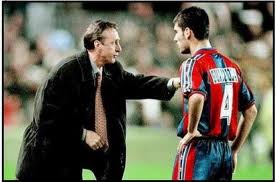
Cryuff & Guardiola: Yoda & the Then-young Jedi
And Cryuff returned to Barcelona in the early ’90s, managing a group of fantastic players called Cryuff’s Dream Team–the “fulcrum” of which was a young midfielder named Pep Guardiola. Now of course Guardiola is manager–and some are saying Guardiola’s current team is better than those Barcelona teams; including some who played alongside Pep back then (“when they won the European Cup for the first time in 1992 and clinched four consecutive league titles between 1991 and 1994. That side featured the likes of Romario, Hristo Stoichkov and Ronald Koeman.)
Cryuff now dispenses his opinions and wisdom with weekly essays that appear in the Barcelona newspaper El Periódico. One of his recent entries was titled “El fútbol total del siglo XXI“–“Total Football for the 21st Century” (“Solo dos equipos, el Madrid de Di Stéfano y el Ajax de los años 70, habían sido capaces hasta ahora de reinventar el fútbol como lo está haciendo el de Guardiola” which translates to: “Only two teams, the Madrid of de Di Stefano and the Ajax of the early ’70s were able to reinvent the game as Guardiola’s team is now doing.”
With Arsenal, a similar “continental” style of play came to north London via France–Arsene Wenger arrived to manage Arsenal in the mid-’90s, after a decade managing in France. Although he’s perhaps best known for bringing to the Premier League French and African (and especially, perhaps, French-African), two of his most influential players in his first decade coaching at Arsenal were Dutch internationals Denis Bergkamps and Marc Overmars–and one of his most important right now is Dutch striker Robin van Persie.
But his most important player, Arsenal’s talisman, if you will, is Cesc Fabregas–a native Catalan whom Wenger signed away from Barcelona’s La Masia seven years ago, when Cesc was only 16. Apparently Cesc was convinced that he wouldn’t have the same opportunities to play at Barcelona that he has had at Arsenal, given the midfield talent that was being groomed at La Masia back then. But now Barcelona now wants to bring Fabregas back–which is one source of conflict between the clubs, and one of the major storylines of these meetings.
As a player, Guardiola was very much the prototype of the modern Spanish midfielder: technically-gifted, balanced and an immaculate passer of the ball.
He was at the heart of Johan Cruyff’s all-conquering Barca side in the 1990s and was idolised by the young Fabregas as he made his way through the academy ranks.
Borrell, who has remained a friend and confidante to Fabregas, tells a story that encapsulates the connection between the Arsenal star and his one-time hero.
In 2001, when Fabregas was going through the pain of his parents’ divorce, Borrell persuaded Guardiola to sign his famous number four shirt for the young protege. On it, he wrote: ‘One day, you will be the number four of Barcelona.’
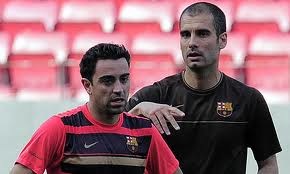
Guardiola & Xavi
But for now, of course, the heart of the Barcelona midfield, the deus ex machina, is Xavi. Messi scores the goals, gets the press, gets the awards–but many thought it was Xavi that should have received the Balon d’Or this year, instead of Messi (but Xavi finished 3rd in the balloting–with Iniesta finishing 2nd!).
You must read this interview with Xavi that Guardian Football’s Spanish correspondent Sid Lowe conducted last weekend. An excerpt:
Think quickly, look for spaces. That’s what I do: look for spaces. All day. I’m always looking. All day, all day. [Xavi starts gesturing as if he is looking around, swinging his head]. Here? No. There? No. People who haven’t played don’t always realise how hard that is. Space, space, space. It’s like being on the PlayStation. I think shit, the defender’s here, play it there. I see the space and pass. That’s what I do.
That’s at the heart of the Barcelona model and runs all the way through the club, doesn’t it? When you beat Madrid, eight of the starting XI were youth-team products and all three finalists in this year’s Ballon d’Or were too – Lionel Messi, Andrés Iniesta and you.
Some youth academies worry about winning, we worry about education. You see a kid who lifts his head up, who plays the pass first time, pum, and you think, ‘Yep, he’ll do.’ Bring him in, coach him. Our model was imposed by [Johan] Cruyff; it’s an Ajax model. It’s all about rondos [piggy in the middle]. Rondo, rondo, rondo. Every. Single. Day. It’s the best exercise there is. You learn responsibility and not to lose the ball. If you lose the ball, you go in the middle. Pum-pum-pum-pum, always one touch. If you go in the middle, it’s humiliating, the rest applaud and laugh at you.
Your Barcelona team-mate Dani Alves said that you don’t play to the run, you make the run by obliging team-mates to move into certain areas. “Xavi,” he said, “plays in the future.”
They make it easy. My football is passing but, wow, if I have Dani, Iniesta, Pedro, [David] Villa … there are so many options. Sometimes, I even think to myself: man, so-and-so is going to get annoyed because I’ve played three passes and haven’t given him the ball yet. I’d better give the next one to Dani because he’s gone up the wing three times. When Leo [Messi] doesn’t get involved, it’s like he gets annoyed … and the next pass is for him.
See below for what Xavi has to say about Arsenal and English football. (With apologies to Sid Lowe and the Guardian, we’ve ended up excerpting the majority of the interview–so click thru and give them a pageview. Or even better, make sure you read everything Sid Lowe writes–no better English-language coverage of La Liga exists, as far as we can tell. In fact, click thru to Lowe’s breakdown of “Three lessons for Arsenal before they take on Barcelona“; namely–1: Internazionale, Champions League, 20 Apr 2010; 2: Sporting Gijón, La Liga 12 Feb 2010; 3: Real Madrid, La Liga 29 Nov 2010.)
The Croatian/Brazilian has scored in 1/2 his UCL games this season
The second day of Champions League knockout action is about to start, with the Ukrainian side sitting tops of their league (having won it last season) while Roma have been smacked around of late, dropping to 8th position a full thirteen points off the lead in the Serie A.
What’s the problem at Rome? There are a few injuries that are causing concern: Striker Marco Borriello has a nagging thigh injury keeping him on the bench, and preferred midfielder David Pizzaro is feeling pain from a recurring knee injury. Of some serious concern is the injury to first choice keeper Julio Sergio, who will be replaced by former first choice Doni. The Italian side should be excited to have their talisman Francesco Totti back in action, though rust may play a part in his finding space amongst the quick midfield of the Girnyky.
The ex-soviet side come into the match having bested Arsenal at home to claim top spot in their group stage. But, speaking of rust, they’re on an extended winter break and haven’t played in roughly two months now. They traveled early, hoping to become accustomed to the 60 degree change in temps (and had a chance to tour the Vatican, how lovely!). What’s most interesting perhaps is the number of samba boys on the side: Adriano (a currently effective version, not the one who may come on for 5 minutes at the end for Roma), Eduardo (Croatian…technically), William, Jádson, Costa, Teixeira, and Fernandinho (out today, unfortunately). Pretty much the entire midfield was born in South America, plus the little spark plug up top.
Roma have historically held firm against the Ukrainian side at home, though they haven’t played in a number of years now and are in the middle of a three-game slump. What’s most concerning is the lack of faith in the gaffer, with Ranieri reportedly having lost the support of his dressing room and the boardroom as well. The well-traveled manager insists nothing is wrong, though concerning the security of his job he has opined, “The coach is like the husband, he’s the last to find out about certain things.”

 Chelsea ran riot in Copenhagen this evening, winning 2-0 with Nicolas Anelka scoring on both sides of the half. The west londoners got just the opposition they needed to turn their sad form around, with the bald Frenchman showing real class against a side who looked very much like they hadn’t played in two months. Torres wasn’t as lucky, though he’s manufacturing chances. Here’s a good summation of his current condition by the guardian liveblog:


 Champions League knockout play now committed to memory, we’re back into the domestic leagues with a touch of cup action in England, and the rest of the world getting on with earning points. As you may know, faithful readers, we tend to look to the
  7:30 am